Text of page 1
Evaluating Subject Matter Eligibility Declarations (SMEDs)
Part 1: Formality Review
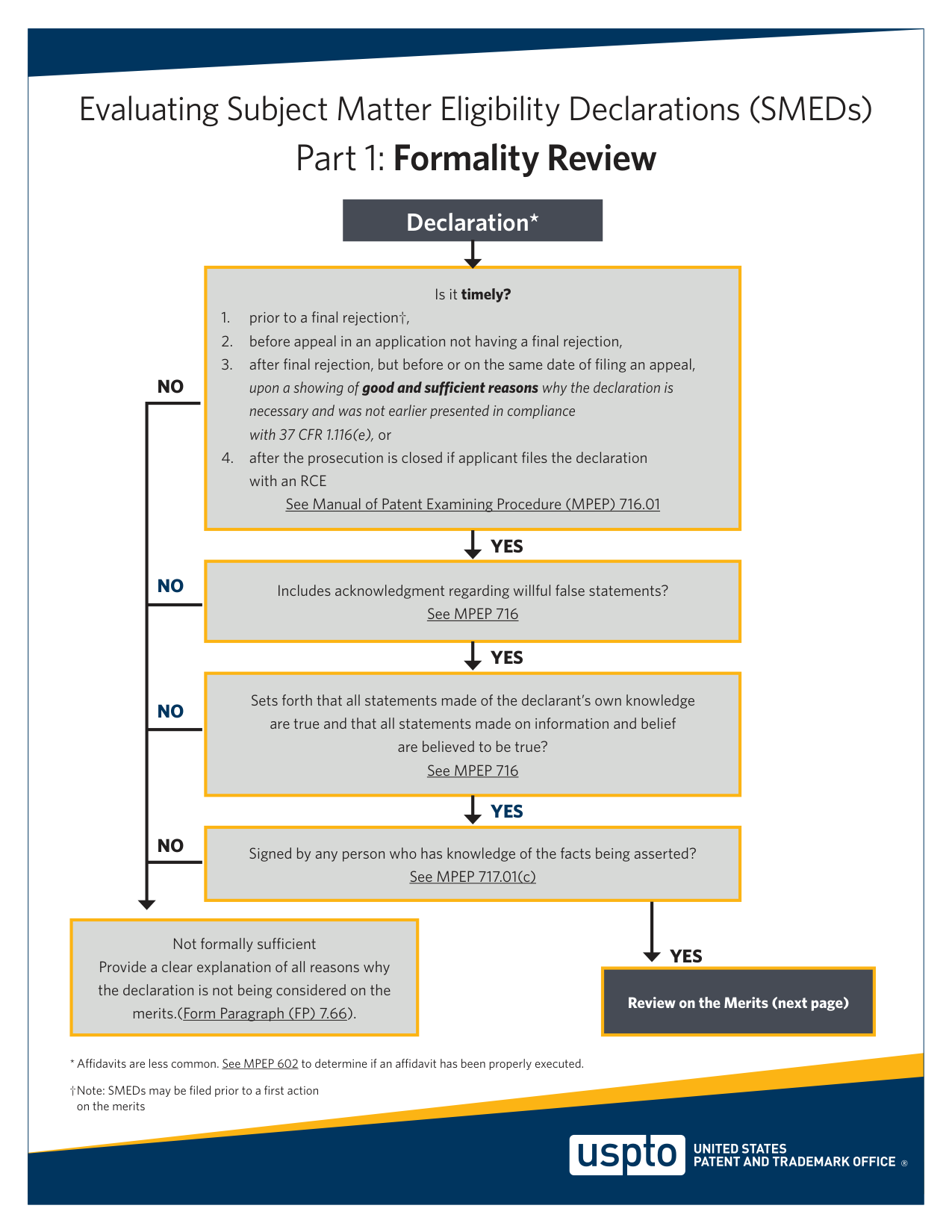
graph TD; Start[Declaration*] --> Q1{Is it timely?}; Q1 -- NO --> End[Not formally sufficient]; Q1 -- YES --> Q2{Includes acknowledgment regarding willful false statements?}; Q2 -- NO --> End; Q2 -- YES --> Q3{Sets forth that all statements made of the declarant's own knowledge are true and that all statements made on information and belief are believed to be true?}; Q3 -- NO --> End; Q3 -- YES --> Q4{Signed by any person who has knowledge of the facts being asserted?}; Q4 -- NO --> End; Q4 -- YES --> Merits[Review on the Merits next page];
Declaration*
Is it timely?
- prior to a final rejection†,
- before appeal in an application not having a final rejection,
- after final rejection, but before or on the same date of filing an appeal, upon a showing of good and sufficient reasons why the declaration is necessary and was not earlier presented in compliance with 37 CFR 1.116(e), or
- after the prosecution is closed if applicant files the declaration with an RCE
See Manual of Patent Examining Procedure (MPEP) 716.01
NO
NO
Includes acknowledgment regarding willful false statements?
See MPEP 716
NO
Sets forth that all statements made of the declarant's own knowledge are true and that all statements made on information and belief are believed to be true?
See MPEP 716
NO
Signed by any person who has knowledge of the facts being asserted?
See MPEP 717.01(c)
NO
Not formally sufficient
Provide a clear explanation of all reasons why the declaration is not being considered on the merits.(Form Paragraph (FP) 7.66).
YES
Review on the Merits (next page)
Flowchart for evaluating SMEDs formalities. It starts with 'Declaration*' and proceeds through four checks: timeliness, acknowledgment of false statements, knowledge of facts, and signature. A 'NO' at any point leads to a box stating it is 'Not formally sufficient' and requires an explanation. A 'YES' to all leads to 'Review on the Merits (next page)'.
* Affidavits are less common. See MPEP 602 to determine if an affidavit has been properly executed.
†Note: SMEDs may be filed prior to a first action on the merits
Text of page 2
Evaluating SMEDs | Part 2: Review on the Merits
Continue from Formality Review
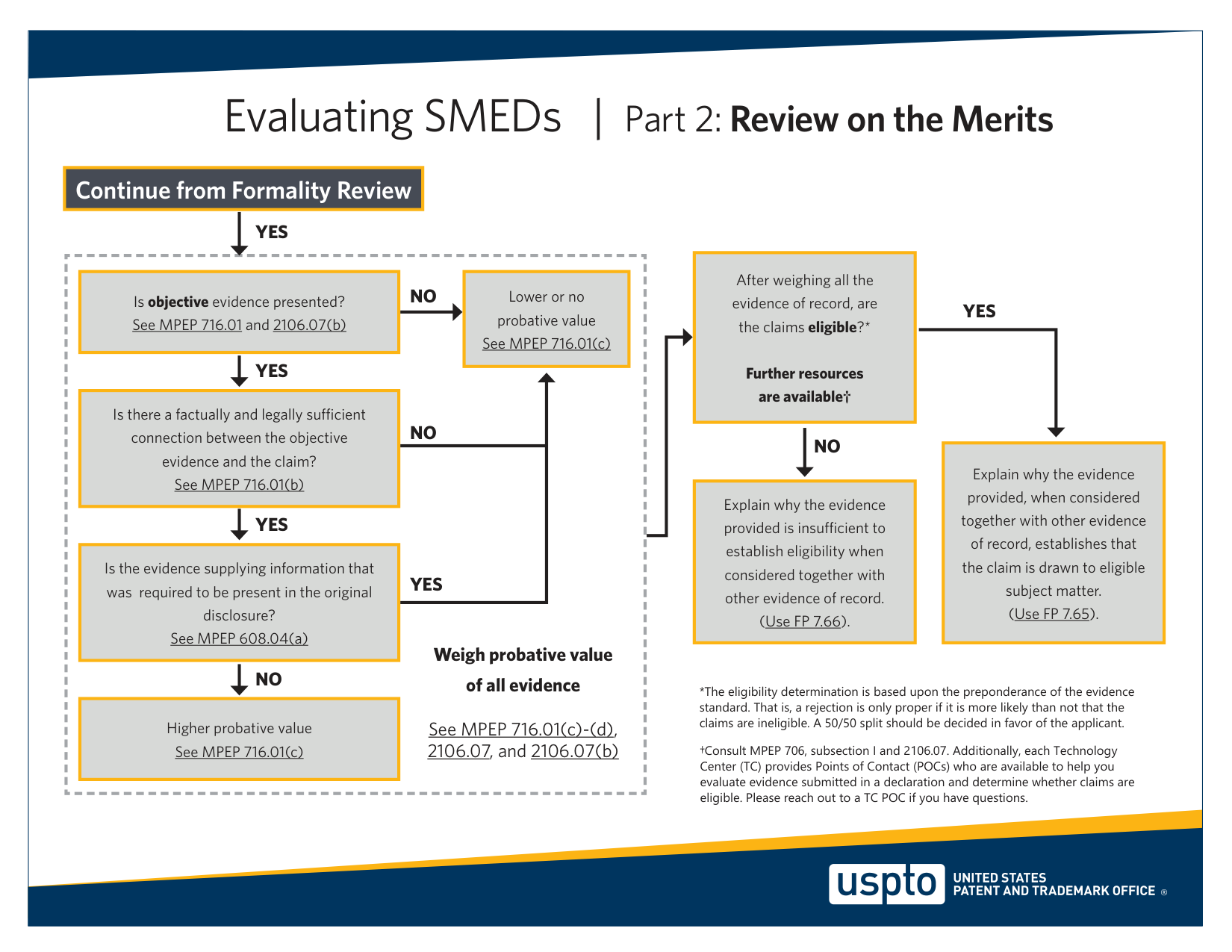
graph TD; Start[Continue from Formality Review] -- YES --> Q1{Is objective evidence presented?}; Q1 -- NO --> LNV[Lower or no probative value]; Q1 -- YES --> Q2{Is there a factually and legally sufficient connection between the objective evidence and the claim?}; Q2 -- NO --> LNV; Q2 -- YES --> Q3{Is the evidence supplying information that was required to be present in the original disclosure?}; Q3 -- NO --> HNV[Higher probative value]; Q3 -- YES --> LNV; LNV --> Q4{After weighing all the evidence of record, are the claims eligible?}; HNV --> Q4; Q4 -- YES --> Explain1[Explain why the evidence provided, when considered together with other evidence of record, establishes that the claim is drawn to eligible subject matter.]; Q4 -- NO --> Explain2[Explain why the evidence provided is insufficient to establish eligibility when considered together with other evidence of record.];
Is objective evidence presented?
See MPEP 716.01 and 2106.07(b)
Is there a factually and legally sufficient connection between the objective evidence and the claim?
See MPEP 716.01(b)
Is the evidence supplying information that was required to be present in the original disclosure?
See MPEP 608.04(a)
Lower or no probative value
See MPEP 716.01(c)
Higher probative value
See MPEP 716.01(c)
Weigh probative value of all evidence
See MPEP 716.01(c)-(d), 2106.07, and 2106.07(b)
After weighing all the evidence of record, are the claims eligible?*
Further resources are available†
Explain why the evidence provided, when considered together with other evidence of record, establishes that the claim is drawn to eligible subject matter.
(Use FP 7.65).
Explain why the evidence provided is insufficient to establish eligibility when considered together with other evidence of record.
(Use FP 7.66).
Flowchart for evaluating SMEDs on the merits, starting from 'Continue from Formality Review'. It branches into 'Objective evidence' and 'Higher probative value' paths, leading to a final eligibility determination based on weighing probative value.
*The eligibility determination is based upon the preponderance of the evidence standard. That is, a rejection is only proper if it is more likely than not that the claims are ineligible. A 50/50 split should be decided in favor of the applicant.
†Consult MPEP 706, subsection I and 2106.07. Additionally, each Technology Center (TC) provides Points of Contact (POCs) who are available to help you evaluate evidence submitted in a declaration and determine whether claims are eligible. Please reach out to a TC POC if you have questions.
uspto logo
UNITED STATES PATENT AND TRADEMARK OFFICE ®