Text of page 1
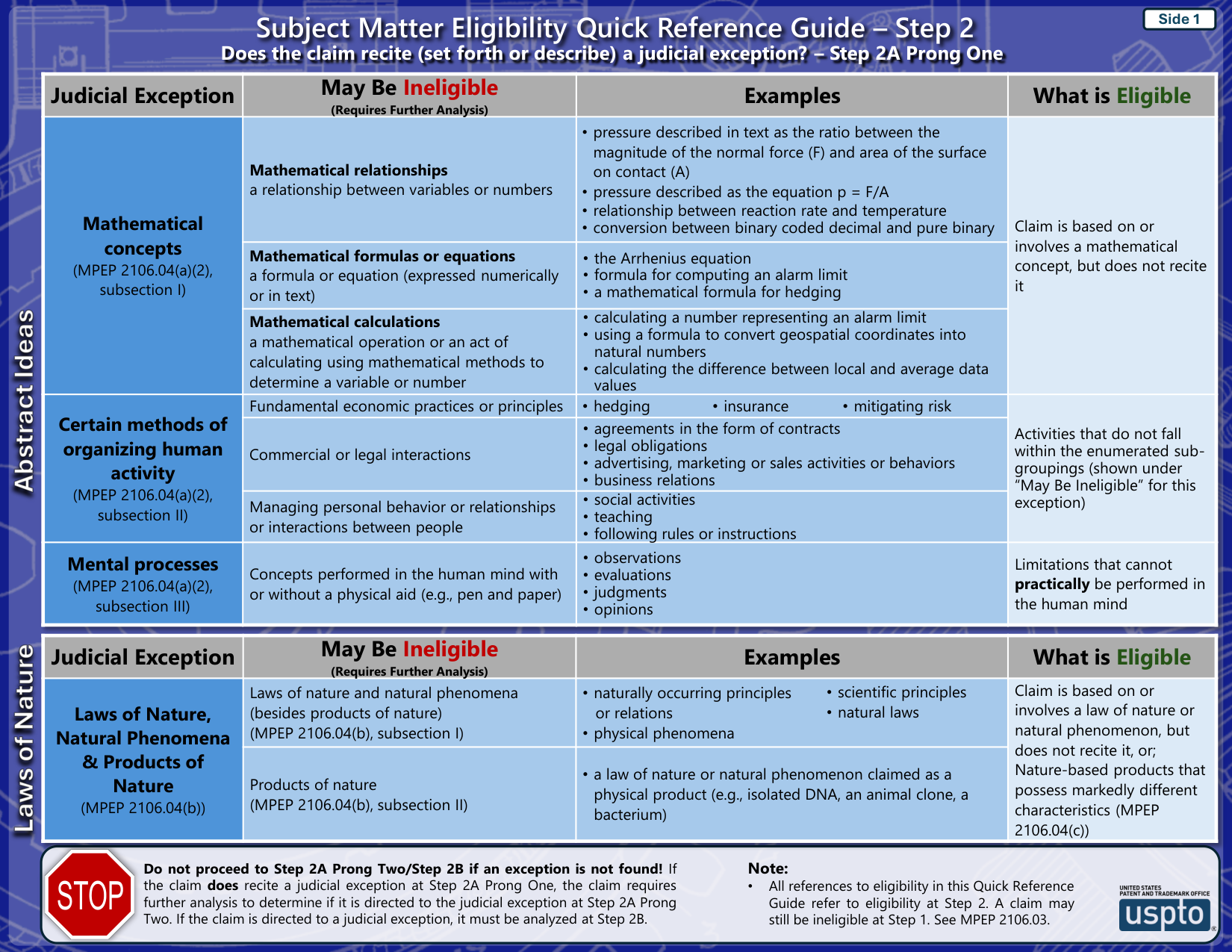
Subject Matter Eligibility Quick Reference Guide – Step 2 Does the claim recite (set forth or describe) a judicial exception? – Step 2A Prong One
| Judicial Exception | May Be Ineligible (Requires Further Analysis) |
Examples | What is Eligible |
|---|---|---|---|
| Mathematical concepts (MPEP 2106.04(a)(2), subsection I) |
Mathematical relationships a relationship between variables or numbers |
|
Claim is based on or involves a mathematical concept, but does not recite it |
| Mathematical formulas or equations a formula or equation (expressed numerically or in text) |
|
||
| Mathematical calculations a mathematical operation or an act of calculating using mathematical methods to determine a variable or number |
|
||
| Certain methods of organizing human activity (MPEP 2106.04(a)(2), subsection II) |
Fundamental economic practices or principles |
|
Activities that do not fall within the enumerated sub-groupings (shown under “May Be Ineligible” for this exception) |
| Commercial or legal interactions |
|
||
| Managing personal behavior or relationships or interactions between people |
|
||
| Mental processes (MPEP 2106.04(a)(2), subsection III) |
Concepts performed in the human mind with or without a physical aid (e.g., pen and paper) |
|
Limitations that cannot practically be performed in the human mind |
| Judicial Exception | May Be Ineligible (Requires Further Analysis) |
Examples | What is Eligible |
|---|---|---|---|
| Laws of Nature, Natural Phenomena & Products of Nature (MPEP 2106.04(b)) |
Laws of nature and natural phenomena (besides products of nature) (MPEP 2106.04(b), subsection I) |
|
Claim is based on or involves a law of nature or natural phenomenon, but does not recite it, or; Nature-based products that possess markedly different characteristics (MPEP 2106.04(c)) |
| Products of nature (MPEP 2106.04(b), subsection II) |
|
Red octagonal STOP sign graphic.
Do not proceed to Step 2A Prong Two/Step 2B if an exception is not found! If the claim does recite a judicial exception at Step 2A Prong One, the claim requires further analysis to determine if it is directed to the judicial exception at Step 2A Prong Two. If the claim is directed to a judicial exception, it must be analyzed at Step 2B.
Note:
- All references to eligibility in this Quick Reference Guide refer to eligibility at Step 2. A claim may still be ineligible at Step 1. See MPEP 2106.03.
Text of page 2
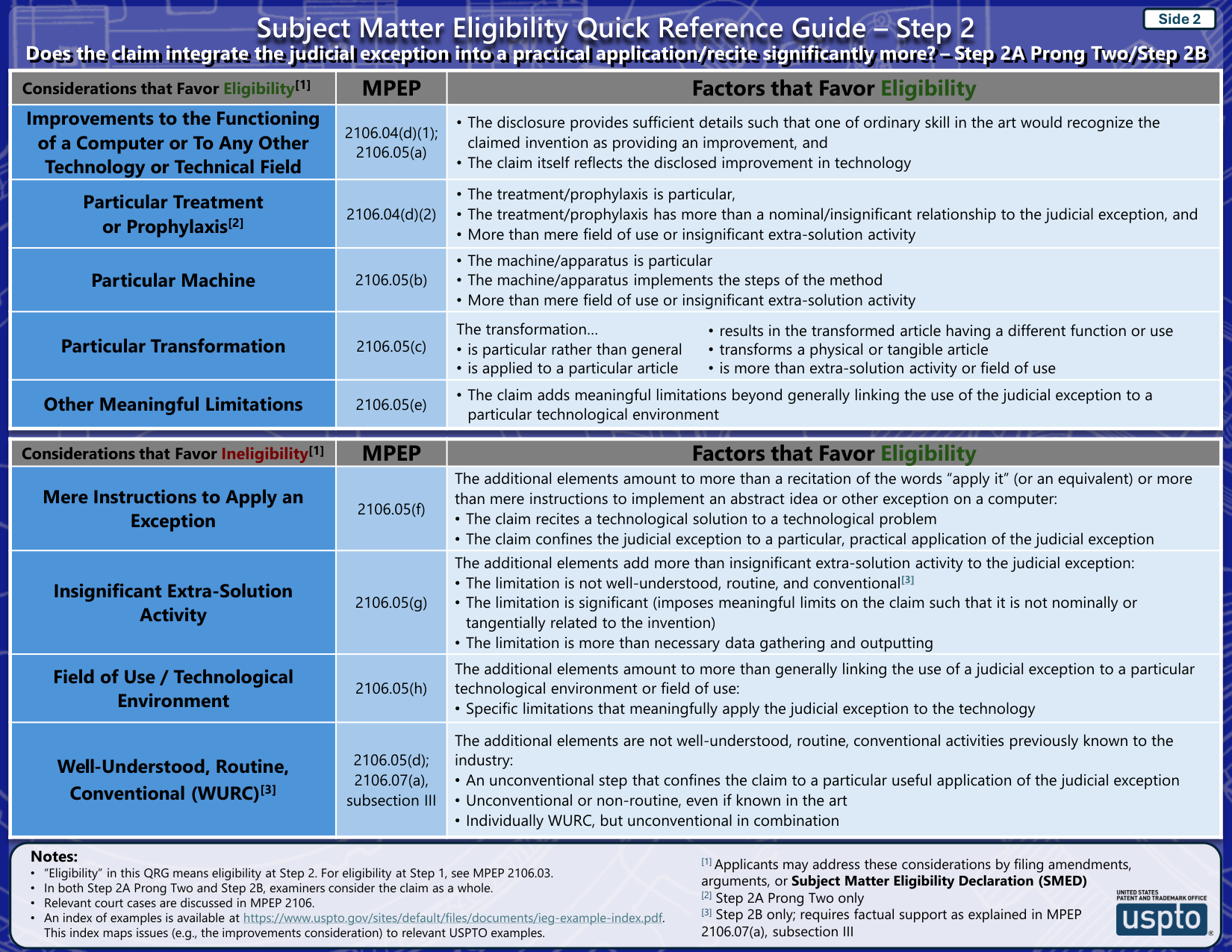
Subject Matter Eligibility Quick Reference Guide – Step 2
Does the claim integrate the judicial exception into a practical application/recite significantly more? – Step 2A Prong Two/Step 2B
| Considerations that Favor Eligibility[1] | MPEP | Factors that Favor Eligibility |
|---|---|---|
| Improvements to the Functioning of a Computer or To Any Other Technology or Technical Field | 2106.04(d)(1); 2106.05(a) |
|
| Particular Treatment or Prophylaxis[2] | 2106.04(d)(2) |
|
| Particular Machine | 2106.05(b) |
|
| Particular Transformation | 2106.05(c) | <div> <div>
|
| Other Meaningful Limitations | 2106.05(e) |
|
| Considerations that Favor Ineligibility[1] | MPEP | Factors that Favor Eligibility |
|---|---|---|
| Mere Instructions to Apply an Exception | 2106.05(f) | The additional elements amount to more than a recitation of the words “apply it” (or an equivalent) or more than mere instructions to implement an abstract idea or other exception on a computer:
|
| Insignificant Extra-Solution Activity | 2106.05(g) | The additional elements add more than insignificant extra-solution activity to the judicial exception:
|
| Field of Use / Technological Environment | 2106.05(h) | The additional elements amount to more than generally linking the use of a judicial exception to a particular technological environment or field of use:
|
| Well-Understood, Routine, Conventional (WURC)[3] | 2106.05(d); 2106.07(a), subsection III | The additional elements are not well-understood, routine, conventional activities previously known to the industry:
|
Notes:
- “Eligibility” in this QRG means eligibility at Step 2. For eligibility at Step 1, see MPEP 2106.03.
- In both Step 2A Prong Two and Step 2B, examiners consider the claim as a whole.
- Relevant court cases are discussed in MPEP 2106.
- An index of examples is available at https://www.uspto.gov/sites/default/files/documents/ieg-example-index.pdf. This index maps issues (e.g., the improvements consideration) to relevant USPTO examples.
[1] Applicants may address these considerations by filing amendments, arguments, or Subject Matter Eligibility Declaration (SMED)
[2] Step 2A Prong Two only
[3] Step 2B only; requires factual support as explained in MPEP 2106.07(a), subsection III